Important
If you need help understanding Peak Activated Data and billing impacts, please read the entirety of this article, watch our Fundamentals of Peak Activated Data video, and then reach out to your customer success manager if you have any additional questions.
Peak Activated Data (PAD) is a billing metric that determines a customer’s highest data usage during a given calendar month. Customers are then billed for extra charges only if their PAD is above the total amount of data they are allotted each month according to their contract.
Data lifecycle
It’s important to understand what kinds of data contribute to a customer’s PAD. Different data components across the data lifecycle will have varying effects on raising data usage, which can lead to overage charges if not monitored and managed.
The below chart follows a typical processing lifecycle for data in Reveal, up until the data is promoted for review. Data in review is always included in each month’s PAD calculation, while data in other stages may or may not contribute to PAD.
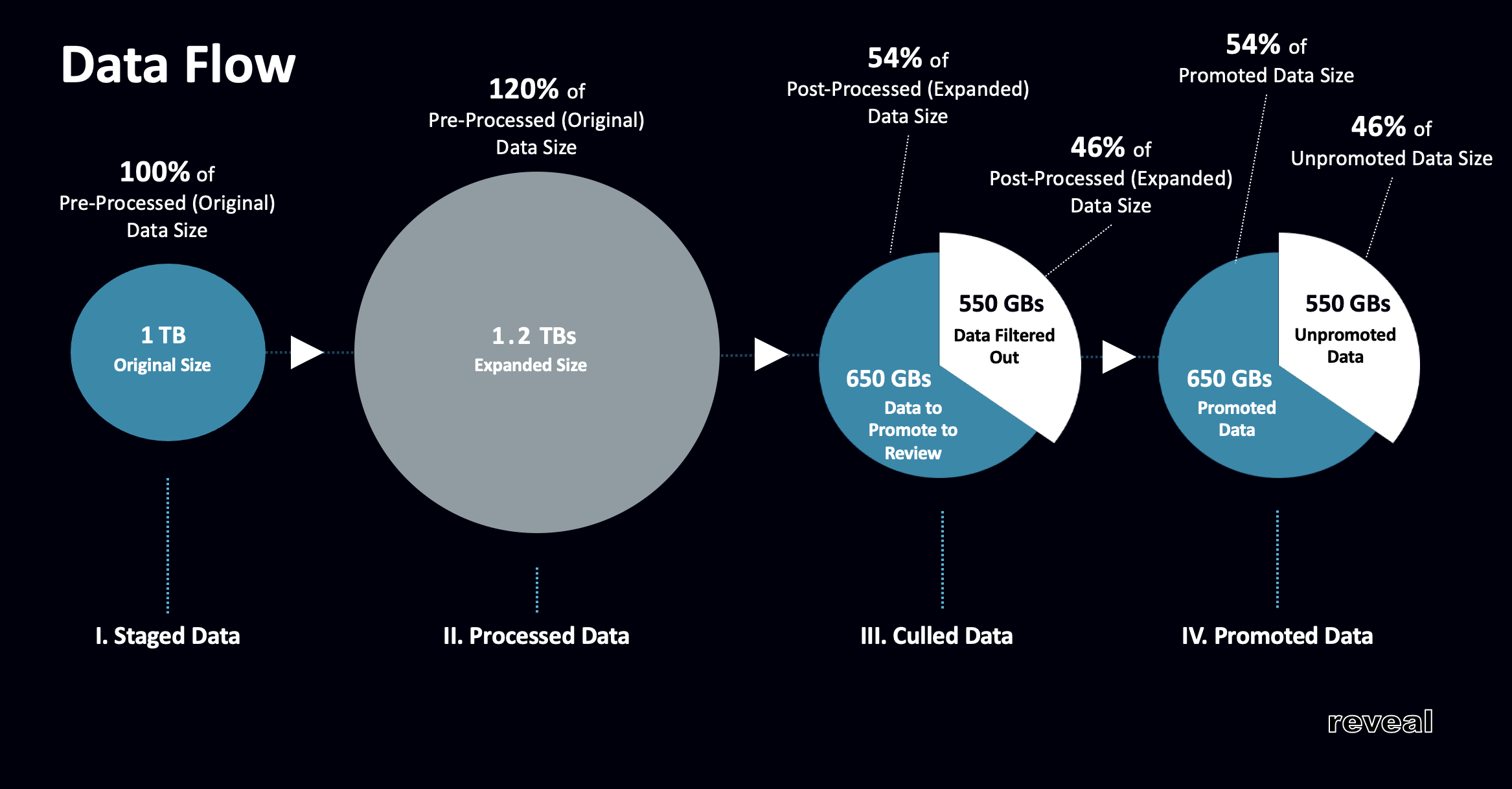
I. Staged data
Data is staged for processing by uploading it into a cloud storage folder. This data is compressed, or pre-processed.
II. Processed data
Data is processed, which expands the data into its true size before it was compressed. The total file size of expanded data will typically increase by some percentage, though there’s no way to predict by how much.
During processing, text and metadata are also extracted, OCR occurs, and data is deduped. After processing, data appears in Reveal’s Processed Files grid.
Data that was just processed is considered Processed Data for the billing month it was processed.
III. Culled data
Data is culled (filtered out) both in the Processed Files grid and in the ECA grid. This may remove a sizable portion of your data, preventing Reviewers from looking at data that is considered irrelevant.
Data in the Processed Files or ECA grid is considered Unpromoted Data.
IV. Promoted data
The remaining data is promoted to the Review grid, allowing the data to fully integrate with Reveal’s data visualizations, AI and analytics, search tools, and document viewer.
Data in the Review grid is considered Promoted Data.
Billing frequency
The three types of data—Processed Data, Unpromoted Data, and Promoted Data—each have different effects on your PAD calculation.
Data Component | Description | Frequency |
|---|---|---|
Processed Data | the pre-processed (original size) size of the processed data. | Only included in PAD calculation in the month the data was processed. |
Promoted Data | The post-processed (Expanded Size) size of the data promoted to Review. | Included each month in PAD calculation excluding the month the promoted data was processed in (to avoid double-counting). |
Unpromoted Data | The post-processed (Expanded Size) size of the data NOT promoted to Review (ECA or Not Promoted Data) | A separate nominal fee will be charged each month for Unpromoted Data (Inactive Data) that exceeds 5x of the customer subscription data allotment across all projects. |
Note
Since 3rd-party data has already been processed, it will jump directly to Review and be charged as Promoted Data.